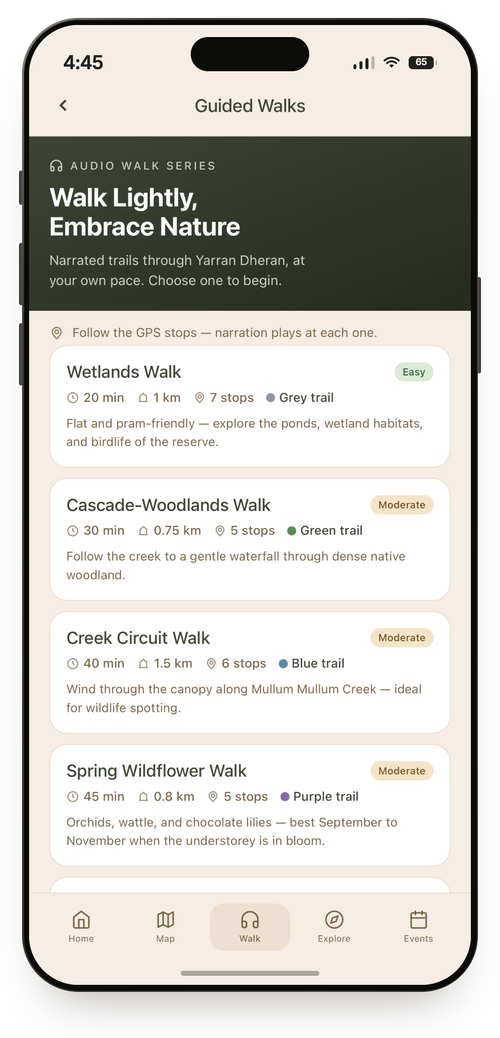
Wetlands Walk

20 mins return (easy terrain)

Start at the Information Centre. Follow the Wetlands Walk shown in WHITE on the map. Before leaving the Information Centre, look at the gardens surrounding the Centre to see a range of the indigenous plants that may be found in Yarran Dheran. Use the iNaturalist app to help you identify plants, insects and wildlife you see in Yarran Dheran.  

The wetlands comprise three ponds which are fed by storm water from surrounding streets and so the level of water in the ponds fluctuates.  The ponds provide a peaceful contemplative setting and you may rest here, using  the ‘Mushroom’ shelter.  

The ponds provide important habitat for waterbirds, including Pacific Black Ducks, Wood Ducks, and Dusky Moorhens, which regularly breed in the top pond. A Little Pied Cormorant is sometimes seen. Eastern Long-necked Turtles are often seen in the third pond, especially in summer. The ponds provide an excellent food source for Eastern Long-necked Turtles, of insects, tadpoles, frogs and yabbies during their life span of up to 50 years.   

If you walk here at dusk or in the evening, you may hear one or more of the seven species of frogs that breed in and near the ponds. Consider participating in the Yarran Dheran Advisory Committee’s Quarterly Frog Survey, using the Frog ID or Frog Census apps. Watch out for snakes in this area – frogs are a favourite food of snakes!

While Tiger Snakes and Eastern Lowland Copperheads are found throughout the Reserve, you will rarely see these creatures, which would much prefer to avoid human contact. Stay on the paths and if you see a snake, quietly allow it to pass by.  

Stand on the footbridge by the third pond and look down at the waterfall which takes the water down to the creek after heavy rain. From here, you will also get a panoramic view of the Mullum Mullum Creek below and the iconic Mullum Mullum Valley.

Return to the Information Centre by walking through the picnic area.

🎧 Walk Lightly, Embrace Nature Series

Gentle, self-guided walks inviting you to slow down, notice the beauty of the Australian bush, and reconnect with nature and yourself. Along the way you’ll discover native plants, birdlife, tranquil ponds, and quiet places for reflection.

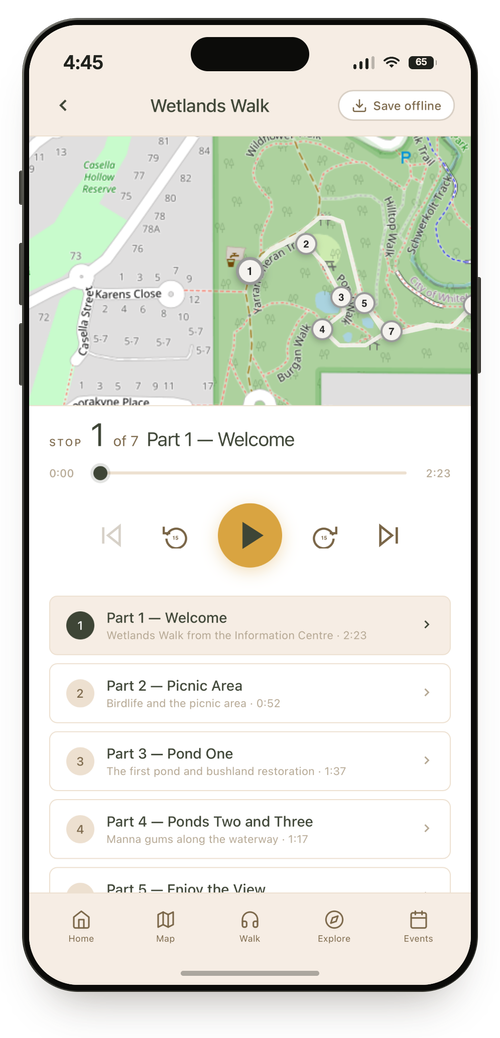
Wetlands Walk

20 min (easy terrain) + optional 15 minute detour (moderate terrain)

Each audio track matches a specific point on the Wetlands Walk. Follow the map and start each recording at the starred locations.

Transcript

  • Welcome to the Walk Lightly, Embrace Nature series. This is the Wetlands Walk, beginning at the Information Centre. The main walk takes around twenty minutes on easy terrain, following the white trail. There is also an optional twenty-minute detour along the creek, which includes steps and a steady uphill return.

    This walk is an invitation to slow down. To observe. And to reconnect, not only with the environment around you, but with your own inner stillness. As you move gently through this place, you may notice that every step offers an opportunity to pay attention to patterns unfolding in nature and, perhaps, within yourself.

    Part 1. Information Centre

    Before you begin walking, take a moment to arrive. Notice the colours of the landscape around you. Many native Australian plants carry silvery, grey-green, or bluish tones, quite different from the bright greens of many introduced species. These muted colours help plants reflect sunlight and conserve water, an adaptation shaped by Australia’s hot, dry climate.

    Early European artists struggled to capture these hues when painting the Australian bush. In response, the Heidelberg School developed new palettes of silvery greens, ochres, and dusty greys, colours that more closely reflected the land itself.

    As you walk today, allow your senses to guide you. Notice what you can see. What you can hear. What you can smell. Just a short time in nature can help settle the nervous system, lift your mood, and support clearer focus.

    Thich Nhat Hanh wrote:
    “From time to time, to remind ourselves to relax and be peaceful, we may wish to set aside some time for a retreat, a day of mindfulness, when we can walk slowly, smile, and enjoy being together as if we are the happiest people on Earth.”

    As you begin walking, you may like to set a simple intention. Perhaps to move with awareness. With curiosity. Or with gratitude. Carry that intention lightly as you follow the white trail.

  • Follow the white path as it opens into the picnic area. You may like to pause here, or take a seat, and observe the birdlife.

    This area is alive with birds: magpies, laughing kookaburras, Little Ravens, Rainbow Lorikeets, Brown Thornbills and White-browed Scrubwrens moving between grass and trees.

    Birds have remarkable hearing. Magpies, for example, listen carefully for the faint sounds of insects and worms beneath the soil.

    Pause for a moment. What can you hear right now? Perhaps nearby calls, or more distant sounds carried on the breeze.

    Continue to Part 3 as you follow the Pond Walk beyond the picnic tables.

  • As you arrive at the first pond, take a moment to slow down. These ponds were created in 1982 as part of Yarran Dheran’s bushland restoration. Over time, they’ve become important habitats for waterbirds, frogs, Eastern Long-necked Turtles, and aquatic insects.

    As ephemeral wetlands, they change with the seasons—filling during wet periods, drying during drought, shifting, adapting, and renewing. This movement is not a failure of the system. It’s the system working as it should.

    At times, you may notice the water looks darker. This is a natural process called a blackwater event, where decaying plant matter temporarily reduces oxygen levels. It can appear dramatic, but it’s a normal part of wetland ecology.

    Take a quiet moment here. Can you see any movement in the water—tadpoles in the shallows, ripples from insects, perhaps a turtle surfacing on a warm day? Noticing gentle, repeating patterns like these has been shown to calm a busy or stressed mind.

    If you’re visiting at dusk, you might hear frogs calling. Even if you don’t, they are here—aware, listening. Like them, you might choose to stay still for a moment, reflecting on your connection with this place, with the beings around you, and with the wider community of life.

    Continue to Part 4 as you walk toward the next two ponds.

  • Turn left onto the Eastlink Trail and cross the footbridge, following the path as it winds through the bushland. Notice how the larger trees above cast patterned shadows on the ground, echoing the shapes of their leaves and branches.

    As you continue, observe how each section of the trail supports a different ecosystem. Near the creek in the riparian zone, the soil is damp and plants thrive in wetter conditions. Further uphill, the ground is drier and different species of trees and shrubs appear.

    Birds, insects, and other wildlife change as well, reflecting the contrast between the riparian zones and the higher slopes. Even though the plant life varies, repeating patterns remain—the way branches spread, leaves cluster, and shapes recur across the landscape.

    Slow your pace. Shift your attention from small details to the wideness of the valley around you. This gentle change of perspective can help settle the mind and broaden awareness. Reflect on your place and role within your family, your community, and the wider ecosystem.

    Joy Harjo wrote:
    “We are a part of the earth’s cycles, not outside them.”

    Continue to Part 5 when you arrive at the Schwerkolt Track intersection.

  • From the footbridge, look down toward the waterfall that channels water into the creek after heavy rain. From here, take in the broad view across Mullum Mullum Creek and the canopy of the Mullum Mullum Valley beyond.

    Pause and listen. Yarran Dheran is home to more than eighty bird species. Their calls shift with the time of day, season, and weather—often quiet during heat or rain, and most lively at dawn and dusk.

    How many different calls can you hear right now? Listening to birdsong has been shown to reduce anxiety and support a sense of wellbeing.

    Julie Zickefoose once wrote:
    “The presence of a single bird can change everything for one who appreciates them.”

    If you wish, continue to Part 6 for the optional creek detour. Otherwise, you may begin returning toward the Information Centre.

  • From the footbridge, follow the trail toward the Yellow Box Track along the creek. As you walk, notice the variety of eucalypts around you. Each has its own form, texture, and character: the smooth-barked Manna Gum, the rough-barked Messmate, the stringy bark of the Long-leafed Box, the flaky yellow tones of the Yellow Box, and the bluish leaves of the Red Box.

    Near the large Manna Gum known locally as the “hugging tree,” turn left onto the Creek Walk toward an area affectionately called “The Beach.” This quiet place is often visited by ducks and small birds. You may like to sit here.

    Listen to the water. Let your awareness settle. You might think of this pause as a small ceremony—a simple act of being in respectful relationship with the place you’re in.

    When ready, return along the same path toward the Information Centre.

Explore our Walks