Creek Circuit Walk

40 mins return (moderate terrain)

Start at the Information Centre. Follow the walk shown in BLUE on the map and walk along  the Wildflower Walk down towards the creek.  Look for a profusion of wildflowers in spring, patches of Nodding Greenhood orchids, and the endemic Small Grass Tree, Xanthorrhoea minor. Look for acacia species.  

There are at least eight species of Acacias in Yarran Dheran ranging from Golden Wattle, A.pycnantha (Australia’s national emblem), blackwood wattle A. melanoxylon to Spreading Wattle A. genistifolia, a low growing understorey shrub with spiky leaves.

Flowering wattles are a feature of Yarran Dheran especially during late Winter and Spring.

Cross the creek at Quarry Road, noting the old quarry site just over the creek. Join the Eastlink Trail to walk through Mullum Mullum Park. Follow the Eastlink Trail and look for towering Manna Gums, Eucalyptus viminalis  which line the creek, while a mix of other locally indigenous Eucalypt species such as Messmate E. obliqua, Long Leafed Box E. goniocalyx, Yellow Box E. Melliodora and Red Box E. polyanthemos dominate the woodland areas. At the bridge, turn right onto the gravel Schwerkolt Track to return to  Yarran Dheran. 
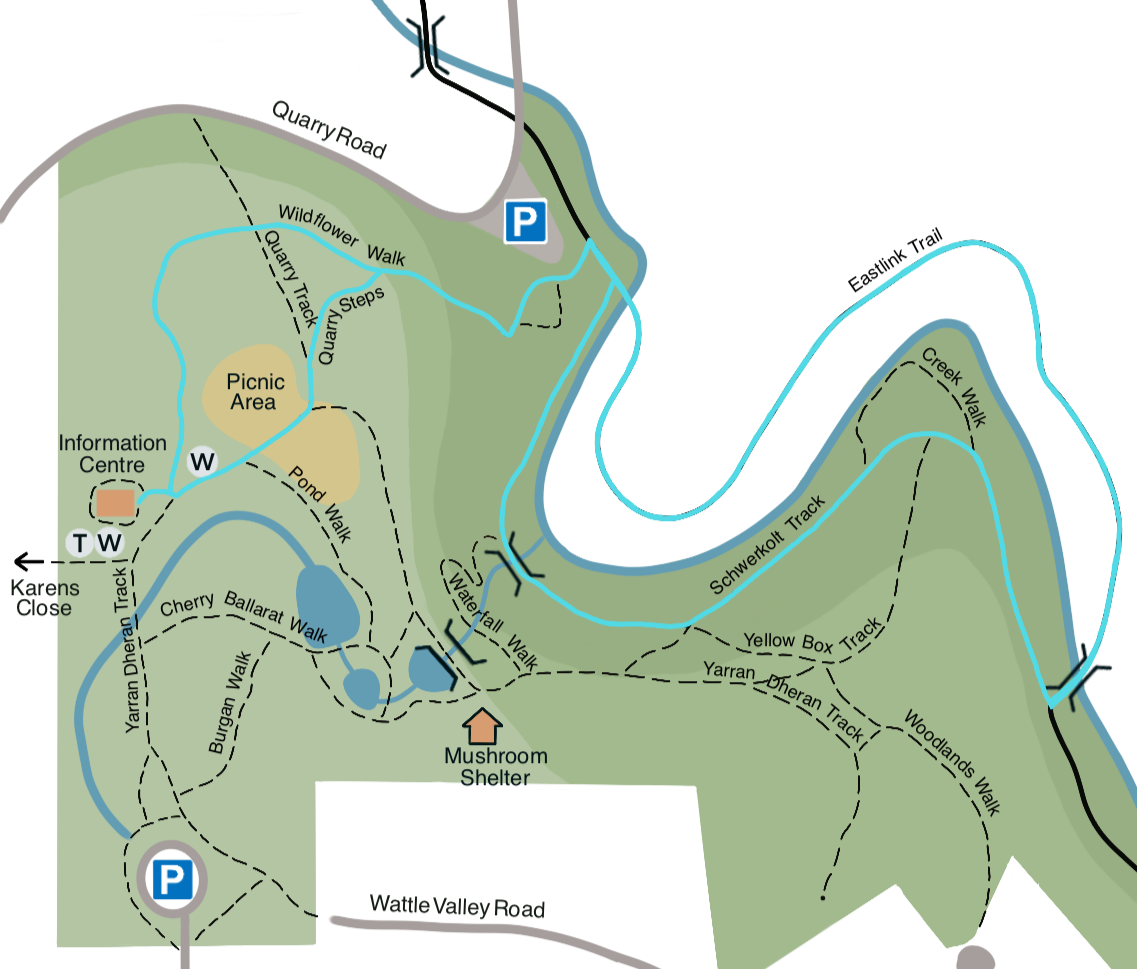
On the way, take a short diversion to your right to take the Creek Walk down to the creek leading to an area locals call ‘The Beach’ where you may see ducks on the water and small birds such as Brown Thornbills and  Eastern Spinebills in the surrounding vegetation. Back on the Schwerkolt Track, look for  Black She-oak   Allocasuarina littoralis and a range of smaller trees and shrubs which make up the middle vegetation story and provide important habitat for birds and other wildlife.

Other species such as Victorian Christmas Bush Prostanthera lasianthos and Woolly Tea Tree Leptospermum lanigerum can be found along the creek whilst Common Cassinia Cassinia aculeata, Hop Goodenia Goodenia ovata and Prickly Tea Tree Leptospermum continentale are scattered through the woodland areas.

You may see the waterfall as a raging torrent if you visit after heavy rain.  

On your left is the old tipface, which despite its unattractiveness, is surprisingly a great place to see small birds in the early morning as it receives the early morning sun. Look for Superb Fairy Wrens, Grey Fantails, and  Red-browed Finches.

Consider participating in the Yarran Dheran Advisory Committee’s monthly bird surveys to see some of the 84 species of birds seen in Yarran Dheran, some of which are not found elsewhere in Whitehorse. Look for waterbirds on the creek. Walk through the picnic area to return to the Information Centre.

🎧 Walk Lightly, Embrace Nature Series

Gentle, self-guided walks inviting you to slow down, notice the beauty of the Australian bush, and reconnect with nature and yourself. Along the way you’ll discover native plants, birdlife, tranquil ponds, and quiet places for reflection.

Creek Circuit Walk

45 min return (moderate terrain)

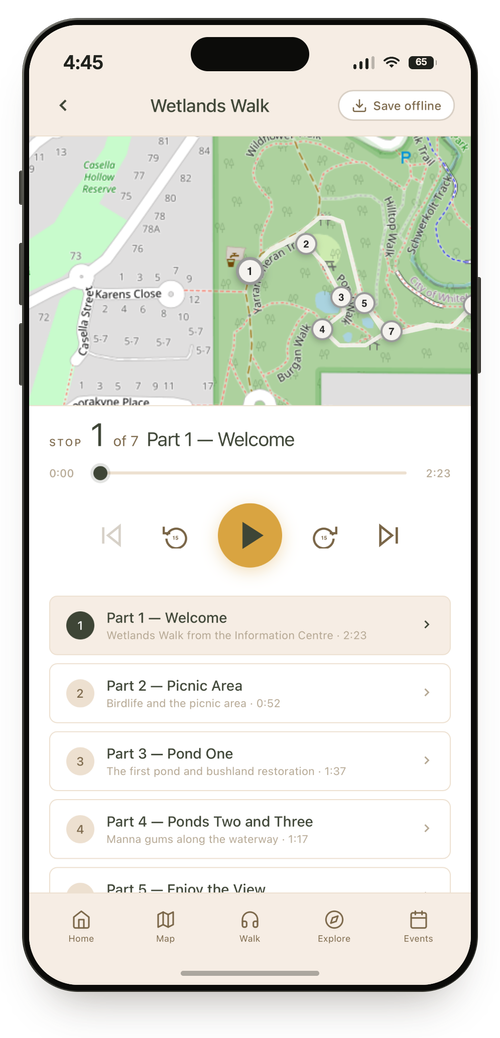
Each audio track matches a specific point on the Creek Circuit Walk. Follow the map and start each recording at the starred locations.

Transcript

  • Welcome to the Walk Lightly, Embrace Nature series brought to you by the Yarran Dheran Advisory Committee. This is the Creek Circuit Walk, beginning at the Information Centre.

    The full walk takes around forty-five minutes on moderate terrain, following the blue trail on your map. This walk invites you to notice fractal patterns throughout Yarran Dheran Reserve. Observing these repeating forms in nature can help reduce stress, sharpen focus, and deepen your sense of connection to the environment.

    But what are fractals?

    Joseph P. Kauffman wrote:
    “Examples of fractals are everywhere in nature. They can be found in the patterns of trees, branches, and ferns, in which each part appears to be a smaller image of the whole. They are found in the branch-like patterns of river systems, lightning, and blood vessels. They can be seen in snowflakes, seashells, crystals, and mountain ranges. We can even see the holographic and fractal-like nature of reality in the structure of the Universe itself, as the clusters of galaxies and dark matter resemble the neurons in our brain, the mycelium network of fungi, as well as the network of the man-made Internet.”

    Start at the Information Centre. Before you begin, pause and look around. Notice the shapes of the trees, the branching limbs, and how their silhouettes repeat in smaller forms. This is one of nature’s most familiar fractals—each part echoing the whole.

    As you set out on the blue trail toward the Wildflower Walk, notice the understorey plants along the path. Look for Kangaroo Grass and Wallaby Grass. These native grasses grow in clumps called tussocks, forming repeating patterns that add rhythm to the landscape.

    They are more than decorative. Female butterflies often lay their eggs on these plants, supporting the next generation of pollinators and adding life to the reserve.

    John Muir wrote:
    “In every walk with nature one receives far more than he seeks.”

    Continue to Part 2 when you reach the Wildflower Walk.

  • Continue along the Wildflower Walk as it descends toward the creek. In spring, wildflowers reveal their own fractal patterns, petals and leaves repeating shapes that mirror the larger plant. Even the smallest ferns reflect these designs, showing how tiny details connect to the wider ecosystem.

    Keep an eye out for species like the Nodding Greenhood Orchid, or scattered bursts of colourful native blooms. Watch insects circle, land, and lift off again, tracing small loops that mirror larger patterns of life across the reserve.

    Pick a tree near the trail. Observe its trunk, follow your eyes up the branches and smaller twigs, and then take in the surrounding space—no tree lives in isolation. Everything in this ecosystem is connected.

    Peter Wohlleben suggests that when a tree is felled, neighbouring trees are left “bereft.” He noted, “There are more life forms in a handful of forest soil than there are people on the planet.”

    What plants and animals do you notice around this tree and how do they share this patch of the world?

    Continue to Part 3 when you reach Schwerkolt Track at the bottom of the hill.

  • Item deTurn right onto Schwerkolt Track. Follow the path along Mullum Mullum Creek, a tributary of the Yarra River. The creek winds through the valley, fed by smaller channels, shaping the land and sustaining a rich variety of life.

    Here you may see Pacific Black Ducks, Wood Ducks, and in spring, families of ducklings paddling behind their mother. These dabbling ducks feed by tipping forward in the water—stirring sediment, spreading seeds, and controlling insect populations. Their routines support biodiversity and reflect the interconnected movements of the creek ecosystem.

    Pause by the water. Watch for ripples, fish, or birds. Notice how the current flows around rocks and plants. Patterns appear not only in still images, but in motion—shapes that shift, repeat, and reform within a living system.

    Albert Einstein wrote:
    “Look deep into nature, and then you will understand everything better.”

    Continue to Part 4 when you reach the East-Link Trail.

  • Turn left onto the Eastlink Trail and cross the footbridge, following the path as it winds through the bushland. Notice how the larger trees above cast patterned shadows on the ground, echoing the shapes of their leaves and branches.

    As you continue, observe how each section of the trail supports a different ecosystem. Near the creek in the riparian zone, the soil is damp and plants thrive in wetter conditions. Further uphill, the ground is drier and different species of trees and shrubs appear.

    Birds, insects, and other wildlife change as well, reflecting the contrast between the riparian zones and the higher slopes. Even though the plant life varies, repeating patterns remain—the way branches spread, leaves cluster, and shapes recur across the landscape.

    Slow your pace. Shift your attention from small details to the wideness of the valley around you. This gentle change of perspective can help settle the mind and broaden awareness. Reflect on your place and role within your family, your community, and the wider ecosystem.

    Joy Harjo wrote:
    “We are a part of the earth’s cycles, not outside them.”

    Continue to Part 5 when you arrive at the Schwerkolt Track intersection.

  • Return along the Wildflower Walk, noticing the soft crunch of gravel underfoot and the subtle shifts of light through the trees. When you reach the turn, take the Quarry Steps to your left and follow the path through the picnic area, letting your pace slow as you take in the surroundings.

    Novelist and poet Cesare Pavese wrote:
    “We do not remember days, we remember moments.”

    Allow yourself to carry that idea with you. Pause, breathe, and pay attention to the small details along the way.

    Optional activity
    Find a quiet spot to pause and reflect on what you’ve observed. Consider how small gestures, brief interactions, or simple choices ripple outward, shaping the broader patterns of your day, your community, and the world around you.

    This concludes the narration for the Creek Circuit Walk. We look forward to having you back again soon.

Explore our Walks