Schwerkolt-Creekside Walk 

60 mins return (moderate terrain)

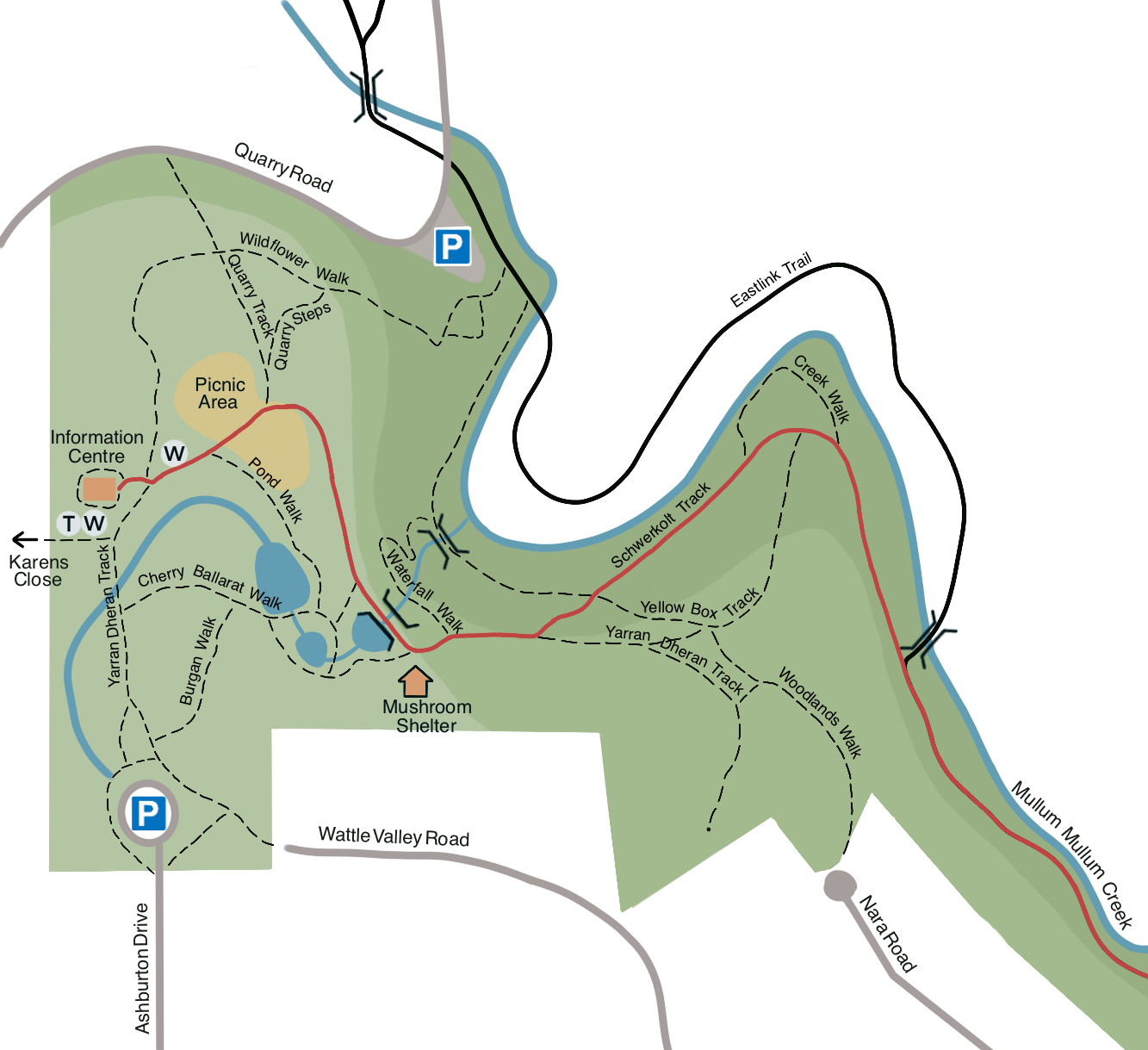
Start at the Information Centre. Follow the track shown in RED on the map. Walk through the picnic area and pass the ponds, to follow Yellow Box Track and then the Schwerkolt Track until you reach Schwerkolt Cottage, open to the public on Saturdays and Sundays. For more information, see https://www.whitehorse.vic.gov.au/things-do/arts-culture/schwerkolt-cottage.  

On the way, note the canopy trees and mid and lower storey woodland vegetation along the Yellow Box Track as described for Walk 3. 

Walking next to the creek gives you a great opportunity to see Pacific Black Ducks and  Wood Ducks, and, in the Spring, families of ducklings. You will also see visible remains of sites used by Augustus Schwerkolt where he quarried for stone to build the Cottage, as well as old fruit trees on your right which h serves as the Schwerkolt family’s orchard area. 

Along the track, also note the very lovely  poles showing Indigenous art which serve as distance markers used for the Mullum Mullum Park Run (Mitcham) a 5 km run/walk/cycle event held every Saturday morning  from Schwerkolt Cottage and through Yarran Dheran.

For more detail see: https://www.parkrun.com.au/mullummullum/course/
🎧 Walk Lightly, Embrace Nature Series

Gentle, self-guided walks inviting you to slow down, notice the beauty of the Australian bush, and reconnect with nature and yourself. Along the way you’ll discover native plants, birdlife, tranquil ponds, and quiet places for reflection.

Schwerkolt-Creekside Walk

40 min return (moderate terrain)

Each audio track matches a specific point on the Schwerkolt-Creek Walk Map. Follow the map and start each recording at the starred locations.v

Transcript

  • Welcome to the Walk Lightly, Embrace Nature series, brought to you by the Yarran Dheran Advisory Committee. This is the Schwerkolt–Creekside Walk, beginning at the Information Centre.

    The walk takes approximately forty minutes return on moderate terrain, following the red trail. This walk invites you to slow down, to breathe, and to notice the land around you.

    This landscape has been shaped over thousands of years by the Wurundjeri Woi‑wurrung people, later transformed through colonisation, and now nurtured through ongoing restoration. As you move, allow curiosity to guide your steps. Pause wherever something draws your attention.

    Part 1. Information Centre

    Before you begin, take a moment to notice where you are. Yarran Dheran is a 7.4‑hectare bushland reserve on the southern bank of Mullum Mullum Creek. It is one of the rare remnants of valley heathy forest remaining in urban Melbourne.

    Notice the air on your skin, the quality of the light, the sounds around you. Even brief time outdoors can be beneficial. Research suggests that as little as ten minutes in nature can help reduce stress and improve mood and focus.

    Buddha once said, “Be where you are; otherwise, you will miss your life.”

    As you begin walking along the red trail, set a gentle intention—perhaps to move with curiosity rather than urgency. You might notice how the gravel feels beneath your feet, or the sound of the wind through the trees. Allow the environment to set the pace.

    Continue to Part 2 as you follow the red track toward the ponds.

  • Follow the red trail along the Yarran Dheran Track, through the picnic area, until you reach the ponds. The streamlet on your right begins at the Ashburton carpark, bringing stormwater to the ponds. As you walk, listen for the sound of frogs, birdsong, and rustling leaves.

    Natural soundscapes such as flowing water and birds have been shown to lower heart rate and reduce anxiety, supporting a calmer nervous system. For tens of thousands of years, this kind of slowing down and careful attention to place has been central to how the Wurundjeri Woi‑wurrung people lived with and cared for this land. Their deep knowledge of waterways and seasonal cycles supported sustainable food, shelter, and movement across Country.

    Writer Bruce Pascoe reflects, “If we are to attempt to understand Indigenous philosophy, it has to begin with the profound obligation to land.” A similar idea is echoed in a proverb that says, “We do not inherit the earth from our ancestors; we borrow it from our children.”

    As you arrive at the ponds, pause for a moment. Notice the ground beneath your feet, the path, the built elements. Then look out across the Mullum Mullum Valley. Consider what this landscape might have looked like three hundred years ago.

    Continue to Part 3 as you make your way down toward the creek.

  • Descend the Yarran Dheran Track, down the Junction Stairs, and arrive at Schwerkolt Track, which follows Mullum Mullum Creek. The creek flows for twenty‑two kilometres, from Croydon to the Yarra River at Templestowe. It acts as an important wildlife corridor, supporting birds and animals as they move in response to food and seasonal change.

    Notice how the water moves, weaving around and over rocks, flowing past fallen branches. The health of the creek is closely tied to the surrounding bushland. Native vegetation filters stormwater, stabilises soil, and reduces erosion. Shade keeps the water cool, supporting fish, insects, and aquatic plants. Fallen leaves and woody debris provide food and shelter. This narrow strip of bushland acts as a living buffer, protecting the creek within an otherwise urban landscape.

    Pause and listen. On warm days, you may hear a hum of birds, insects, and frogs. Notice the layers of life around you—the movement and the quiet moments in between. Are there signs of the city here, or does the bush feel like a world apart? Allow yourself to settle into the rhythm of the reserve.

    Continue to Part 4 as you follow Schwerkolt Track toward the cottage.

  • As you continue along Schwerkolt Track, notice signs of the current season: bird calls, flowering plants, insect activity, subtle shifts in temperature. While many people recognise four seasons, the Wurundjeri Woi‑wurrung people observe seven local seasons, each marked by changes in weather, plants, animals, and even the night sky.

    You might be walking during Orchid Season, when orchids flower and wattles bloom; or Tadpole Season, when rain continues and frogs and birds become more active; perhaps during the Dry Season, marked by heat and low rainfall; or Eel Season, when temperatures cool and manna gums flower. These seasons reflect close observation and deep attunement to place. Slowing down enough to notice such changes can foster a sense of belonging, even in an urban environment.

    You may like to sit on one of the benches along the track. Allow yourself a few slow breaths. Observe the seasonal signs around you. Enjoy the changes in plants over the seasons. Acacias provide a riot of colour over winter and spring. You might pick up the smell of the Native Mint Bush on the breeze—find one of these plants and enjoy the scent even more when you crush the leaves between your fingers. In summer, look for the white flowers of the Victorian Christmas Bush along the track. As you walk, notice the branches and rustling foliage high in the giant Manna Gum next to the path as birds come and go.

    Thich Nhat Hanh wrote, “Feelings come and go like clouds in a windy sky. Conscious breathing is my anchor.”

    Continue to Part 5 as you approach Schwerkolt Cottage.

  • As you ascend toward Schwerkolt Cottage, notice the old fruit trees on the right, remnants of the Schwerkolt family orchard. Those that still survive are pear trees. Some have colonised on the other side of the path next to the creek and continue even now to provide fruit for birds.

    Augustus Schwerkolt purchased land here in 1861 and built his first stone house around 1864, using stone he quarried from within Yarran Dheran. The house was destroyed by fire in 1905, and the current Schwerkolt Cottage, built around 1884–1885 during his second marriage, used stone quarried from the creek and timber from the property. Remarkably, the cottage survived the bushfires of 1905 and was restored in 1964. It is now one of the few nineteenth‑century stone cottages in metropolitan Melbourne still standing on its original site. The former orchard in the mid‑twentieth century was leased out for horse agistment, and the area continues to be identified by locals as “the horse paddock.”

    European settlement transformed the landscape. Bushland was cleared for farming, orchards, and vineyards, while Schwerkolt quarried stone, cultivated orchards, and produced wine, reshaping the valley. Because charcoal is much easier to transport than timber, many trees were cut down and burnt to provide charcoal for the needs of the growing Melbourne. By the mid‑twentieth century, most of these activities had ceased, and focus shifted toward conservation and restoration, in particular through the influence of the Antonio brothers who farmed land in Antonio Park.

    The Schwerkolt Cottage and Museum Complex are open on Saturdays, Sundays and public holidays from 1pm to 4pm (closed on Good Friday and Christmas Day). Inside, you can explore the three‑room pioneer cottage furnished in the style of the period, as well as outbuildings, a barn, wine cellar, smokehouse and local history displays that tell the story of early settlement in this valley and the lives of the people who lived here.

    Painter Vincent van Gogh famously said, “Do go on doing a lot of walking and keep up your love of nature, for that is the right way to understand art better and better. Painters understand nature and love her and teach us to see.”

    Take a mindful moment here. Notice the trees around you. Are they young or old? What clues suggest their age? Observe the textures, shapes, and patterns in the landscape. When ready, begin your return along Schwerkolt Track.

  • As you walk back, notice the wooden markers along the trail featuring Indigenous artwork. These poles mark distances for the Mullum Mullum Parkrun, a weekly event that brings people together through movement, connection, and shared use of this space.

    Yarran Dheran exists today because of generations of community care—from advocacy to protect the valley from development to the volunteers who regularly plant, weed, and monitor wildlife, as well as providing a focus for environmental education to raise appreciation and understanding of the environmental values of the Mullum Mullum Valley. In turn, the reserve supports the community, offering a space for reflection, exercise, and connection to nature. This ongoing exchange, with people caring for the land and the land caring for people, helps both the bushland and the community thrive.

    Albert Einstein wrote, “Look deep into nature, and then you will understand everything better.”

    Activity: You may also like to cross the footbridge across the grassed field. If you follow the stairs upward, there is a lookout which provides a scenic view of the canopy of trees and the Schwerkolt Cottage parkland.

    Alternatively, you may prefer to simply watch the creek from the footbridge. This bushland is a home for a variety of birds like the Little Pied Cormorant and Pacific Black Duck. The Little Pied Cormorant often dives beneath the surface to chase fish, crustaceans, and insects, using its feet for propulsion. In contrast, ducks may be seen dabbling along the creek, submerging their heads and necks while keeping their tails in the air to reach vegetation and insects. Take a moment to appreciate the creek. Can you see any ripples or movement beneath the water?

    Continue to Part 7 as you return to the Information Centre.

  • As you arrive back at the Information Centre, notice how the landscape feels now compared to when you began. This reserve tells a story of stewardship, disruption, and repair—a reminder that change is constant, and renewal is possible.

    Andy Goldsworthy wrote, “We often forget that we are nature. Nature is not something separate from us.”

    As you leave, consider how you might carry this attentiveness into daily life—perhaps through a mindful walk, watching a bird, or tending a garden. In doing so, you continue the quiet work of care, linking yourself to the land and to the community that sustains it.

    This concludes the audio narration for the Schwerkolt–Creekside Walk. We hope you enjoy exploring the other walks within Yarran Dheran Nature Reserve, and we look forward to welcoming you back again soon.

Explore our Walks